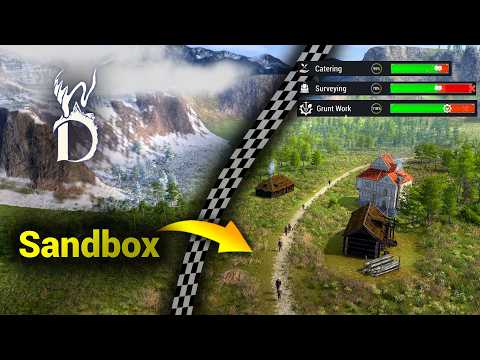
This is the story of implementing what I've learned into a gridless, interactive, world-building sandbox game called Minor Deity.
Minor Deity on Steam: https://store.steampowered.com/app/3876240/Minor_Deity/
Minor Deity Discord Server: https://discord.gg/2NEb4HxwhF
Wildfires are dynamic. They almost always start small, like a spark of inspiration, the smallest of ideas. Often that’s all they ever amount to, before being forgotten in time. But sometimes the brightest sparks are offered time’s quill; fuel as ink; and temperature, wind and lack of abundant moisture as a canvas. And then they burn forth with the self-sustaining energy of exothermic reactions as unbridled imagination. They write stories, which turn into epics, touching everything around them, changing the landscape forever. But even the longest epic eventually ends, leaving the world canvas to gather what’s left and take life on again, as best it can manage.
And that’s what I wanted to see happening in my game, Minor Deity. Because up to now, my fires didn’t actually do anything – they were merely some visual particles on pre-determined locations. It was time to add a story, and a story needs characters. Luckily, I already have plenty of those implemented and ready to play their part. Our world canvas contains an underlying grid of up to 160,000 hexes. Each one of these hexes already has values for exposure, surface water, groundwater, temperature, erosion, wind speed and riverbed strength. For even more granular control, our world also contains an underlying grid of up to about 9 million square grid points, each with an elevation and slope, as well as a few things that help with rendering more realistic-looking landscapes, like whether it’s under a tree, part of a building’s floorplan, or has a road going over it. Every single terrain pixel smoothly interpolates between the 4 closest hexes and the four closest grid-points to determine exactly how it should be rendered.
The existing characters that are going to play a role in our fire frontier simulation are elevation, slope, surface water, temperature, wind speed and riverbed strength. To these we will add two more. The first indicates the intensity of the fire on each hex, and the second, what percentage of its fuel has been consumed. And that completes our cast. Let’s listen to their story.
00:00 The Stories of Wildfires
00:48 Introducing the Characters
02:25 Simulating the Story
04:02 Interesting Relationships
04:51 The Recovery Starts
05:38 The Shaders
06:42 Fly-Through