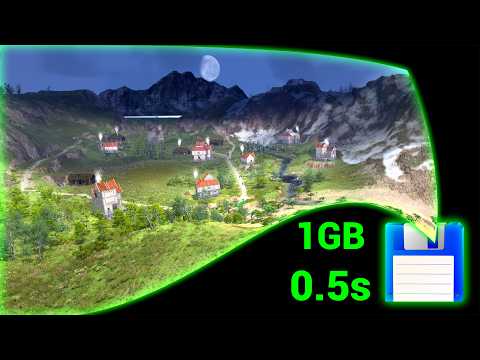
These towns contain dozens of buildings and hundreds of units each, all connected through a gridless network of roads, bridges and sea routes. The catch is that none of these connections are fixed. Players can add or remove routes at any time, while natural disasters can cut entire regions off from the network. It becomes crucial for buildings and units to instantly reconnect to the changing network to stay active. Here's how it works.
If a network is restricted to a square grid, there are a number of limitations that make it easier to work with. Roads can only flow in 4 directions on a square grid, or 8 if diagonal movement is allowed. Distances become simple to compute in blocks, and the grid itself handles most of the spatial structure. The same goes for hex grids, with 6 fixed directions. But our roads are gridless, flowing freely in any direction, at the expense of a lot more complexity.
This is the story of implementing what I've learned into a gridless, interactive, world-building sandbox game called Minor Deity.
Minor Deity on Steam: https://store.steampowered.com/app/3876240/Minor_Deity/
Minor Deity Discord Server: https://discord.gg/2NEb4HxwhF
00:00 Introduction
00:25 Grid vs Gridless
00:54 Nodes + Segments = Graph
01:50 Placing Buildings
02:24 Finding the Closest Road
02:56 Optimization
03:47 Units
04:21 Outro